THE ANALOG HYPERCAR
PORSCHE CARRERA GT
No traction control. No stability aids. Pure driving.
No traction control. No stability aids. Pure driving.
The Porsche Carrera GT is widely regarded as the last great analog supercar — a car built before electronic nannies softened the driving experience. There is no traction control. No stability management system. No paddle shifters. Just a naturally aspirated V10, a 6-speed manual gearbox, a ceramic clutch, and your skill as a driver. That's it.
The engine's origin story is the stuff of legend. Porsche developed a 5.7-liter V10 for a Le Mans prototype program that was cancelled when Porsche shifted focus to the Cayenne. Rather than let the engine die, engineer Walter Röhrl — Porsche's legendary test driver — championed a road car project to showcase it. The result was the Carrera GT: a mid-engine, rear-drive supercar with a carbon fiber monocoque and a racing engine detuned for road use.
That V10 produces 605 horsepower at 8,000 RPM and is mounted so low in the chassis that the engine sits below the driver's shoulder line. The sound it produces — a metallic, high-pitched shriek that builds to a crescendo — is considered by many automotive journalists to be the single greatest engine note ever produced by a road car.
5.7L Naturally Aspirated V10
605 HP at 8,000 RPM — Le Mans derived6-Speed Manual
Birch wood shift knob — Porsche tradition1,380 kg (3,042 lbs)
Carbon fiber monocoque tubCeramic Composite
First road car with PCCC — notoriously tricky590 Nm (435 lb-ft)
Available at 5,750 RPMNone
No TC, no SC, no ABS intervention — pure analog
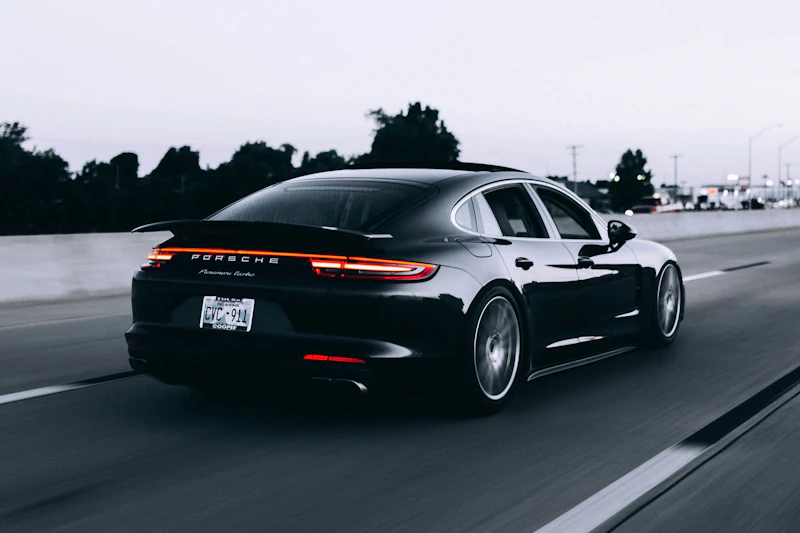
The Carrera GT's proportions are classic mid-engine supercar: long nose, compact cabin pushed forward, and wide rear haunches shrouding massive rear tires. The active rear wing deploys at speed to generate downforce, while the underbody features a fully sealed carbon fiber floor with dual venturi tunnels for ground effect.
The removable carbon fiber roof panel stows behind the seats, transforming the GT into a targa. The birch wood shift knob — a nod to Porsche's 917 Le Mans racers, which used wooden shifters to save weight — is one of the most iconic interior details in automotive history.
The raised door sills require an ungainly entry — a reminder that the car's carbon monocoque tub was designed for structural rigidity, not convenience. Once seated, the view over that long hood, with the V10 rumbling behind your head, is one of motoring's greatest sensory experiences.